

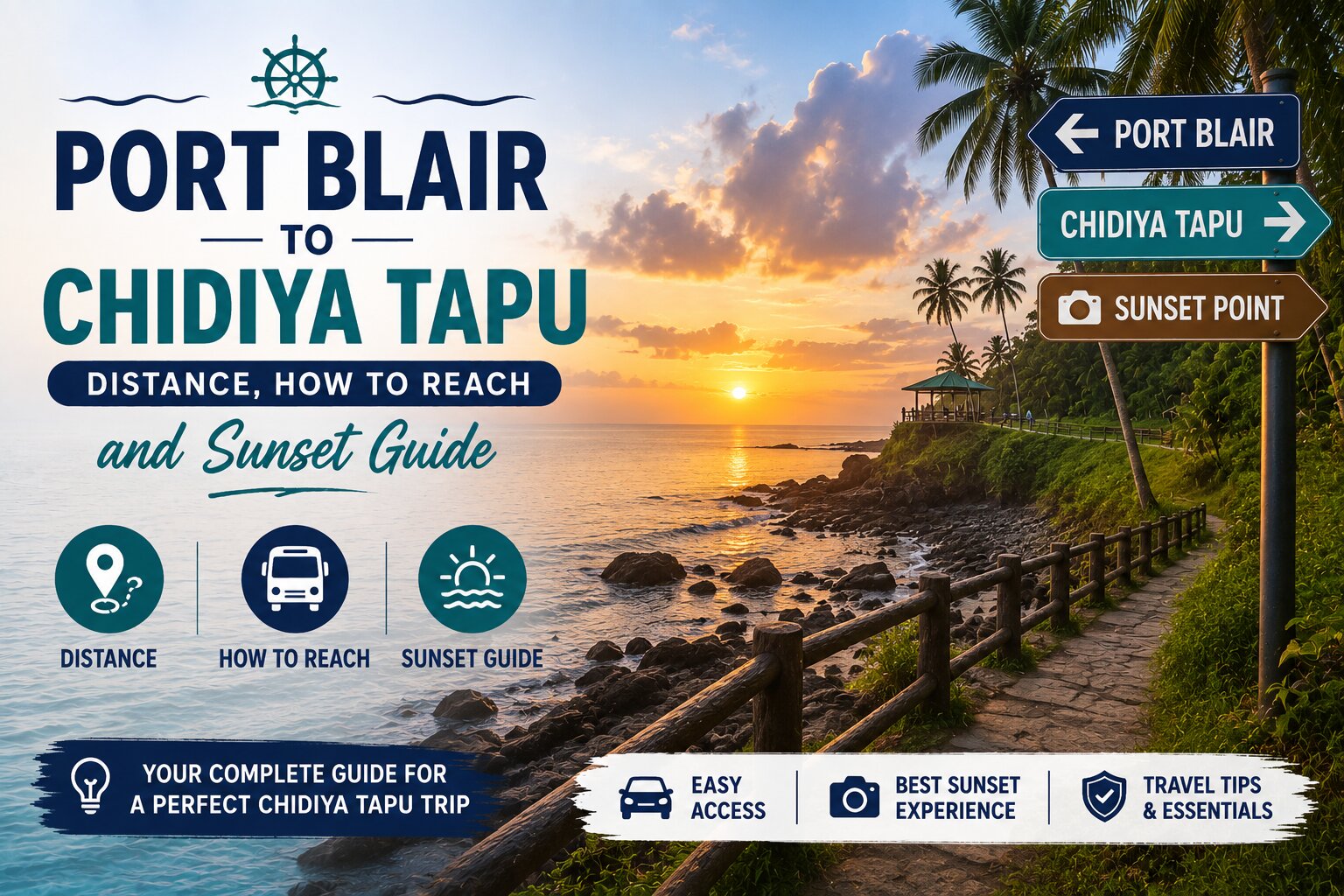
Port Blair to Chidiya Tapu at a glance
TL;DR: Chidiya Tapu sits about 25 km south of Port Blair, a 45 minute to one hour drive by taxi, local bus, or your own scooter. In our view it is South Andaman’s best free sunset point, wrapped in mangrove and birding forest. Come by late afternoon, and do not plan to swim here.
Suggested Read: Snorkelling in Andaman and Places to visit in Andaman
The Port Blair to Chidiya Tapu run is one of the easiest half-day trips you can add to an Andaman itinerary, and one of the most rewarding if you get the timing right. Most people come for the sunset. What they do not expect is the forest, the birds at first light, and a short hill walk that opens onto the sea. Our team on the ground in Port Blair sends travellers down this road most weeks, so here is exactly how the trip works, what it costs, and what to skip.
How far is Chidiya Tapu from Port Blair?
Chidiya Tapu is about 25 km from Port Blair, and the drive takes 45 minutes to an hour depending on traffic through town and the state of the forest road. Some signboards and older guides quote 30 km, measured from different points in the city, so do not be thrown if your driver’s odometer reads a little more or less.
The route heads south out of Port Blair, past the outskirts and into progressively greener country. The last stretch is a winding forest road with tree cover on both sides. This is the southernmost point of South Andaman that most visitors reach easily by road, which is part of why the light out here feels different from the busier beaches up north.
How do you get from Port Blair to Chidiya Tapu?
You have four realistic options: a private taxi, the local bus, a rented scooter or car, or a booked half-day tour. Most first-time visitors take a taxi and hold it for the return, because public transport back after sunset is unreliable.
By taxi, the simplest option
A one way taxi runs roughly 600 to 1,000 rupees, and a round trip with the driver waiting for sunset is usually 1,200 to 1,800 rupees as of early 2026. Agree on the waiting time before you leave, because the entire point of this trip is the light at the end of the day. Fares climb during peak season in December and January, so confirm the number up front rather than at the drop-off.
By local bus, cheapest with a catch
State buses leave from the STS bus stand in Port Blair for around 45 to 50 rupees per person and run roughly hourly through the day. The catch is the return. Service thins out after 5 pm, which is exactly when the sunset crowd wants to head back. Take a bus and you risk being stranded or forced to leave before the sky peaks. We only suggest the bus for an early birding trip, not for the sunset.
By rented scooter or car
A scooter is the freedom option and the road is genuinely pretty, but the last stretch is a winding forest with weak mobile signals and animals crossing at dusk. Ride it in daylight, carry your licence, and try to start the return before full dark. Self-drive cars are less common on the islands, so most visitors take a car with a driver rather than driving themselves.
On a half-day tour
Many Port Blair sightseeing circuits fold Chidiya Tapu into an afternoon that also covers nearby spots. This is the low-stress choice if you would rather not negotiate fares or watch the clock yourself.
What is there to do at Chidiya Tapu?
Four things carry the trip: the sunset point, the Munda Pahad forest walk, dawn birding, and the biological park on the way in. The beach itself is for looking, not swimming.
1. The sunset point
This is why Chidiya Tapu earns its reputation. The west-facing shore, backed by silhouetted trees and exposed mangrove roots, turns the sky orange and pink as the sun drops toward the water. Sunset falls between about 5 pm and 6 pm depending on the season. Arrive 60 to 90 minutes early to claim a spot on the rocks and watch the colour build rather than rushing in for the final ten minutes.
2. Munda Pahad trek
A short 1.5 km forest trail climbs to a viewpoint over the sea and takes about 30 to 40 minutes round trip. It is gentle, shaded, and fine for families with older kids. Watch the gate. Entry to the trek generally closes around 3 pm, so this is a plan-early activity, not something you tack on after the sunset. If the walk matters to you, build the whole afternoon around it.
3. Birdwatching at Bird Island
Chidiya Tapu means Bird Island, and the name is earned at dawn, not dusk. Early mornings bring parakeets, drongos, kingfishers, and white-bellied sea eagles working the forest edge and the shoreline. Serious birders come at first light with local guides who know where the Andaman endemics tend to sit. If birds are your reason for coming, this is a morning trip, not a sunset one.
4. Chidiya Tapu Biological Park
A short distance before the beach, the biological park keeps native Andaman species including saltwater crocodiles and spotted deer, and it works well as a first stop on the way in. Entry is modest, around 20 to 25 rupees for Indian visitors, with camera charges extra. Reported timings vary by source and season, and the park is usually shut one day a week, so confirm locally before you build it into a tight schedule.
When is the best time to visit Chidiya Tapu?
Come between October and May for clear skies and clean sunsets, and arrive in the last 90 minutes of daylight. The monsoon months, June to September, bring clouds and rain that flatten the sunset, though the forest is at its greenest and the birds are active.
There are really two best times here, and they pull in opposite directions. For the sunset, evening in the dry season wins. For birds, early morning wins, and the season matters less. You cannot do justice to both in the same short visit, so decide what you are coming for before you fix the hour. Weekends in season get busy on the rocks, so a weekday evening gives you more room and quieter photos.
Can you swim at Chidiya Tapu?
No. Swimming is not allowed at Chidiya Tapu. Saltwater crocodiles use the surrounding mangrove creeks, and the seabed is rocky with unpredictable currents. Treat this as a look-only beach.
There are warning signs along the shore, and nets have been placed near the water in the past because of crocodile sightings. Stay on the rocks and the sand, keep children close, and do not wade into the mangrove-fringed water, especially at dawn or dusk when crocodiles are most active. This is not a beach to test the rules on. The reward here is the light and the wildlife, not the water.
How to time the Chidiya Tapu run so you actually catch the sunset
The most common mistake is treating Chidiya Tapu as a whenever trip. The sunset is the one fixed point that will not move for you, so plan the afternoon backwards from it. Pick one of two plans, because the forest walk and the sunset do not fit in the same window.
Plan A: sunset only, what most travellers want
● Leave Port Blair by about 3:30 to 4 pm.
● Reach Chidiya Tapu by 4:30 to 5 pm and settle on the rocks.
● Hold your taxi with an agreed waiting charge.
● Skip Munda Pahad. Its gate closes to new entries around 3 pm, well before the good light.
Plan B: birds and the forest walk
● Leave Port Blair around 6 am for first light.
● Bird the forest edge, then clear Munda Pahad before the 3 pm gate.
● Be back in town by lunch.
Time it right
● Sunset is roughly 5:00 to 5:10 pm in peak winter, and drifts past 6 closer to summer.
Do not get caught out
● The dark drive: the last 8 to 10 km is a winding forest with animals and weak phone signals. Budget 45 to 60 minutes back and do not plan it as if it were daylight.
● On a scooter, that dark ride is the real risk, not the sunset. Carry a working headlight and take it slow.
● Little reliable food at the point, so carry water and a snack.
● Mangrove forest means mosquitoes at dusk, so pack repellent.
Planning your Andaman trip with andamantourism.org
We are a local, Andaman-based operator, not a mainland agency reselling a route it has never driven. Our team lives and works in Port Blair, and the Chidiya Tapu run is one we send travellers on most weeks. That is why we can tell you the sunset drifts past 6 pm in summer, that the Munda Pahad gate shuts around 3, and which drivers will wait through the sunset without fuss. We book the vehicle, brief the driver on timing, and slot Chidiya Tapu into a Port Blair day so you are not wasting an afternoon or racing the light.
If you are building a wider trip, see our guide to things to do in Port Blair and our Andaman honeymoon packages that pair the Chidiya Tapu sunset with Havelock and Neil.
Port Blair to Chidiya Tapu FAQ
How far is Chidiya Tapu from Port Blair?
About 25 km, a 45 minute to one hour drive. A few sources quote 30 km depending on the start point in the city.
How much does a taxi from Port Blair to Chidiya Tapu cost?
Roughly 600 to 1,000 rupees one way, and 1,200 to 1,800 rupees for a round trip with the driver waiting for sunset, as of early 2026. Fares rise in the December to January peak.
Is there a bus to Chidiya Tapu?
Yes. State buses run from the STS bus stand in Port Blair for around 45 to 50 rupees, roughly hourly by day. Returns get unreliable after 5 pm, so the bus suits morning trips more than sunset visits.
What is the best time to see the Chidiya Tapu sunset?
Arrive 60 to 90 minutes before sunset, which falls between about 5 pm and 6 pm depending on the season. October to May gives the clearest skies.
Can you swim at Chidiya Tapu beach?
No. Swimming is not allowed because of saltwater crocodiles in the mangrove creeks, a rocky seabed, and strong currents. Enjoy it as a look-only beach.
Do you need a permit for Chidiya Tapu?
You do not need a special permit to visit Chidiya Tapu. It sits in South Andaman and is reached directly from Port Blair. Foreign nationals should carry their passport as identification.
Is Chidiya Tapu worth visiting?
Yes, if you come for the sunset, the birding, and the short forest walk. No, if you are expecting a swimming beach. Set that expectation and it rarely disappoints.